
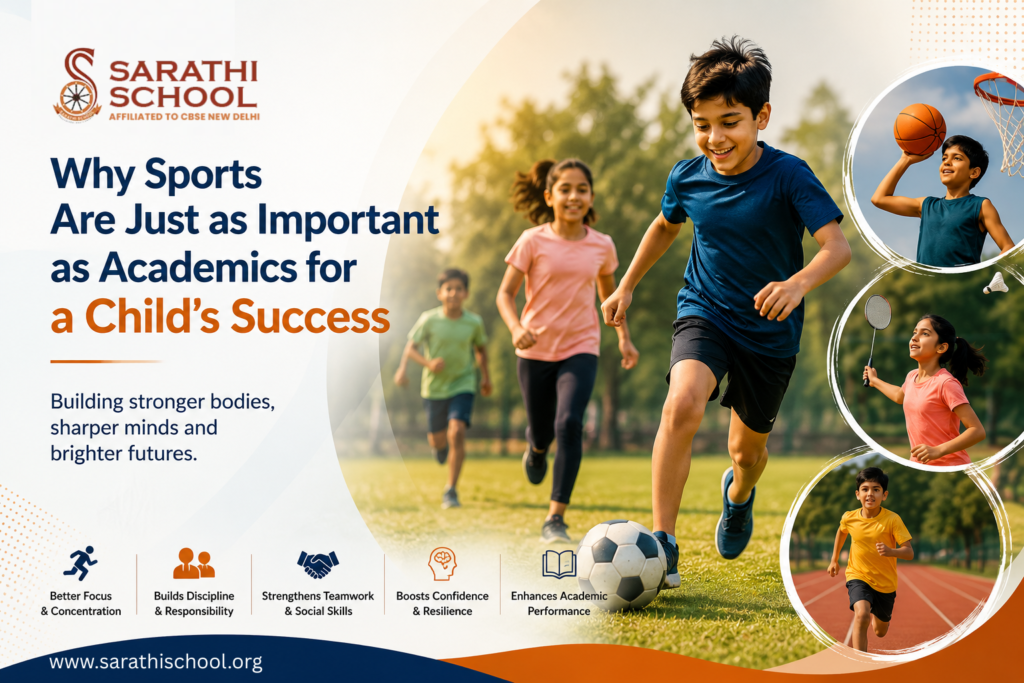
Why Sports Are Just as Important as Academics for a Child's Success
Every parent wants to see their child succeed.
Good grades, academic achievements, and a strong educational foundation are dreams shared by almost every family. Parents invest significant time and effort in ensuring their children receive the best possible education because they understand how important it is for their future.
But as children grow, many parents begin to realize that success is about much more than marks on a report card.
A child may excel academically, but can they confidently express their ideas?
Can they work effectively with others?
Can they handle setbacks without losing motivation?
Can they stay calm under pressure and adapt to challenges?
These qualities play a major role in determining how successful children become in life.
Interestingly, many of these essential life skills are developed not only inside the classroom but also through sports and physical activities.
Today, educators around the world recognize that sports are not simply recreational activities. They are a powerful tool for helping children develop physically, emotionally, socially, and academically.
⚽ The Playground Is an Extension of the Classroom
When people think about education, they often imagine textbooks, lessons, examinations, and homework. While these are important components of learning, education extends far beyond academics.
Children learn valuable lessons every day on the playground and sports field.
When students participate in sports, they learn how to follow rules, work with teammates, listen to instructions, and remain committed to a goal. They learn the importance of practice, consistency, and perseverance.
Unlike classroom learning, where concepts are often explained through words, sports allow children to experience lessons firsthand. They understand the value of teamwork when they work together toward a common objective. They learn patience when progress takes time. They learn responsibility when their actions affect the entire team.
These experiences shape character in ways that traditional learning alone cannot achieve.
🌟 Sports Help Children Build Confidence
Confidence is one of the most valuable qualities a child can develop.
Many children struggle with self-doubt at different stages of their education. Some may hesitate to participate in class discussions. Others may be nervous about trying something new or fear making mistakes.
Sports provide children with opportunities to challenge themselves in a supportive environment.
Whether it is scoring a goal, completing a race, learning a new skill, or simply participating in a team activity, every achievement contributes to a child’s self-belief.
Children begin to realize that success comes through effort and practice. They become more willing to step outside their comfort zones and take on new challenges.
Over time, this confidence extends beyond sports. It begins to influence how they interact with classmates, participate in classroom activities, and approach academic challenges.
🧠 Physical Activity Supports Better Academic Performance
Many parents worry that spending time on sports may take away from study time.
However, research and experience often show the opposite.
Regular physical activity helps improve blood circulation and increases the flow of oxygen to the brain. This supports concentration, memory, and cognitive function.
Children who engage in sports often return to their studies feeling refreshed and energized. They are better able to focus during lessons, absorb information, and remain attentive throughout the school day.
Physical activity also helps reduce fatigue and improve sleep quality, both of which are essential for effective learning.
A healthy body creates the foundation for a healthy and active mind.
🏆 Learning How to Handle Success and Failure
One of the most important lessons sports teach is how to deal with both victory and defeat.
In academics, children often focus on achieving the correct answer or earning high marks. While these accomplishments are important, life does not always go according to plan.
Sports help children understand that failure is not the end of the journey.
Every athlete experiences losses, mistakes, and setbacks. Through these experiences, children learn resilience. They understand that improvement requires effort and persistence.
When they lose a match, they learn how to recover and try again. When they make mistakes, they learn how to improve rather than give up.
These experiences help children develop emotional strength that serves them well throughout their lives.
🤝 Developing Teamwork and Leadership Skills
The ability to work effectively with others is a skill that will benefit children throughout their academic and professional lives.
Sports naturally encourage collaboration and communication.
Students learn how to support teammates, share responsibilities, and contribute to a common goal. They discover that success often depends on collective effort rather than individual achievement.
At the same time, sports create opportunities for leadership. Children learn how to motivate others, make decisions, and take responsibility when challenges arise.
These experiences help them develop interpersonal skills that are difficult to teach through traditional classroom instruction alone.
😊 Supporting Emotional Well-Being in Today's World
Children today face increasing academic pressure and social challenges.
From examinations and assignments to extracurricular commitments and digital distractions, many students experience stress at a young age.
Sports provide a healthy and productive outlet for managing these pressures.
Physical activity releases energy, improves mood, and promotes emotional balance. It gives children opportunities to relax, enjoy themselves, and build positive relationships with their peers.
Regular participation in sports can contribute to better mental well-being, greater self-esteem, and a more positive attitude toward learning and life.
A happy and emotionally healthy child is often more motivated, engaged, and successful in school.
🚀 Preparing Children for Life Beyond School
The world children will enter as adults is changing rapidly.
Future success will depend not only on academic knowledge but also on qualities such as adaptability, collaboration, communication, resilience, and leadership.
Sports help nurture these qualities naturally.
Children learn how to work toward goals, handle pressure, solve problems, and stay committed even when faced with challenges.
These experiences prepare them not just for examinations but for real-life situations where confidence, determination, and teamwork matter just as much as knowledge.
🎓 A Balanced Approach to Education
True education focuses on developing the whole child.
Academic excellence is important, but so are physical health, emotional well-being, confidence, creativity, and social development.
Schools that encourage participation in sports create opportunities for students to grow in all these areas.
At Sarathi School, we believe that education should nurture every aspect of a child’s development. Alongside academics, students are encouraged to participate in sports and physical activities that help build discipline, teamwork, confidence, and a healthy lifestyle.
Because when children are given opportunities to learn, play, explore, and grow, they develop into well-rounded individuals who are ready for the future.
❤️ Final Thoughts
Years from now, children may not remember every lesson they studied or every test they completed.
But they will remember the confidence they gained, the friendships they built, the challenges they overcame, and the determination they developed through experiences both inside and outside the classroom.
Sports are not simply an extracurricular activity.
They are an essential part of helping children become stronger learners, healthier individuals, and more confident human beings.
And that is why sports are just as important as academics in a child’s journey toward success.
📢 Admissions Open for 2026–27
At Sarathi School, we believe that true education goes beyond textbooks. By combining academic excellence with sports, co-curricular activities, values, and holistic development, we help students grow into confident, capable, and future-ready individuals.
If you are looking for a school that nurtures both the mind and the body, while encouraging every child to discover their unique potential, Sarathi School offers an environment where children can truly thrive.
Admissions for the Academic Year 2026–27 are now open.
👉 Visit our campus or connect with our admissions team to learn how Sarathi School can support your child’s journey towards a brighter and more successful future.
Because great futures are built not only in classrooms—but also on playgrounds, sports fields, and through every experience that helps a child grow.


