Sarathi School, Habsiguda, Hyderabad

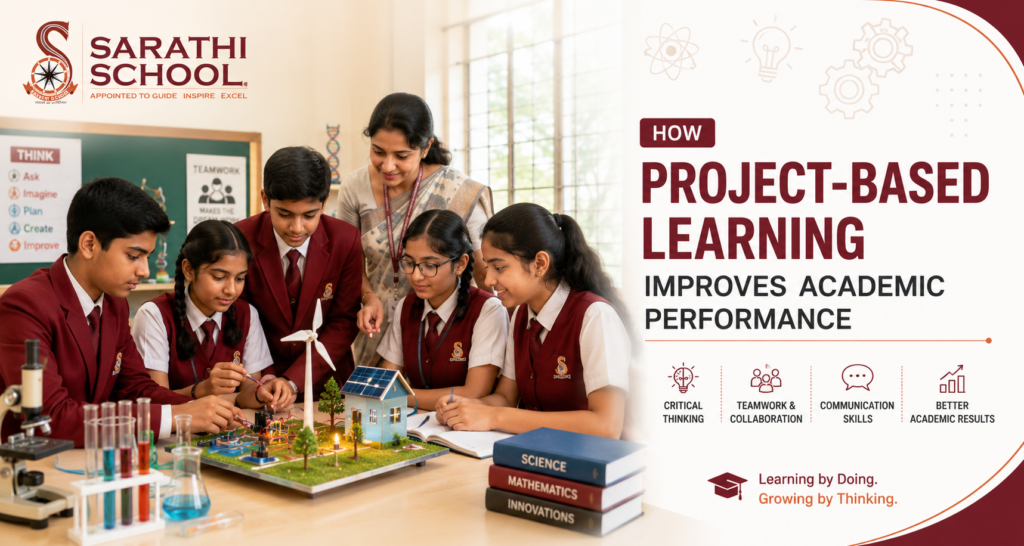
How Project-Based Learning Improves Academic Performance: Learning Beyond the Textbook
In today’s world, education is no longer just about completing textbooks or preparing for examinations.
Parents want their children to understand concepts, think independently, solve problems, and confidently face real-life challenges. While academic excellence remains important, the way children learn has evolved significantly.
Many parents now find themselves asking questions like:
“Is my child truly understanding what they’re learning?”
“Will classroom lessons help them in the real world?”
“How can learning become more engaging and less stressful?”
“What teaching methods help children perform better academically?”
The answer lies in creating learning experiences that go beyond memorization and encourage children to actively participate in their education.
One such approach is Project-Based Learning (PBL)—a teaching method that helps students learn by exploring, creating, collaborating, and solving meaningful problems.
At Sarathi School, we believe that when children are actively involved in the learning process, they develop deeper understanding, stronger confidence, and a genuine love for learning.
As education continues to evolve, let’s explore how Project-Based Learning is helping students improve their academic performance while preparing them for the future.
📚 Learning That Goes Beyond Memorization
For many years, classrooms focused mainly on remembering facts and reproducing them during examinations.
While remembering information is important, true learning happens when children understand the “why” behind every concept.
Project-Based Learning shifts the focus from simply memorizing answers to actively discovering knowledge. Students work on meaningful tasks, research ideas, discuss solutions, and apply what they learn in practical situations.
Instead of asking, “What is the correct answer?” students begin asking, “How does this work?” and “Can we solve this differently?”
This curiosity creates a stronger connection with the subject, making learning both enjoyable and effective.
When children understand concepts rather than memorize them, they naturally become more confident learners.
🧠 Stronger Understanding Leads to Better Academic Results
One of the biggest advantages of Project-Based Learning is that students develop a much deeper understanding of the topics they study.
Imagine learning about environmental conservation by creating a recycling project, or understanding mathematics by applying calculations to real-life situations.
These experiences help students connect classroom lessons with the world around them.
Instead of forgetting information after an exam, children retain concepts for a much longer time because they have experienced them firsthand.
This stronger understanding often reflects in better classroom participation, improved problem-solving skills, and stronger academic performance.
Learning becomes meaningful—not just memorable.
🤝 Teamwork Helps Children Learn From One Another
Success in today’s world depends not only on individual knowledge but also on the ability to work with others.
Project-Based Learning encourages students to collaborate, exchange ideas, and complete tasks together.
While working in teams, children learn how to:
- Listen respectfully to different opinions.
- Share responsibilities.
- Communicate their ideas clearly.
- Solve challenges together.
- Appreciate the strengths of others.
These collaborative experiences not only improve social skills but also help students gain new perspectives that strengthen their understanding of academic concepts.
Learning together often becomes one of the most rewarding parts of the classroom experience.
💡 Encouraging Creativity and Critical Thinking
Every child has unique ideas and talents waiting to be discovered.
Project-Based Learning gives students the opportunity to think creatively instead of simply following fixed answers.
Whether they are designing a science model, preparing a presentation, conducting research, or creating innovative solutions, students are encouraged to explore different possibilities.
They learn to ask thoughtful questions, analyze information, evaluate ideas, and make informed decisions.
These critical thinking skills become valuable not only during school but throughout their academic and professional lives.
Children become confident thinkers rather than passive learners.
🎤 Building Confidence Through Presentation and Communication
Knowledge becomes even more valuable when students can confidently express it.
Project-Based Learning often includes presentations, discussions, demonstrations, and group activities where students explain their ideas to teachers and classmates.
Initially, some children may feel hesitant.
But with regular opportunities to speak, present, and participate, they gradually become more confident communicators.
They learn how to organize their thoughts, answer questions, and express themselves clearly.
Over time, this confidence extends beyond the classroom and positively influences every aspect of their personality.
🎯 Better Academic Performance Through Active Learning
Academic success is not simply about studying harder.
It is about learning smarter.
Students involved in Project-Based Learning often perform better because they actively engage with the subject instead of passively reading information.
As they research, discuss, experiment, and apply concepts, they develop stronger analytical abilities and better retention of knowledge.
This helps them:
- Understand lessons more thoroughly.
- Remember concepts for longer periods.
- Solve application-based questions with confidence.
- Improve classroom participation.
- Develop independent learning habits.
When students enjoy learning, academic improvement becomes a natural outcome.
🏫 How Sarathi School Encourages Project-Based Learning
At Sarathi School, learning is designed to inspire curiosity, creativity, and meaningful participation.
Project-Based Learning is thoughtfully integrated into classroom experiences to help students connect academic concepts with practical applications.
Students are encouraged to participate in:
- Science experiments and working models.
- Mathematics activities that promote logical thinking.
- Environmental awareness projects.
- Art-integrated learning experiences.
- Language-based creative assignments.
- Collaborative classroom presentations.
- Research-based activities that encourage exploration.
These learning experiences help children become active participants rather than passive listeners.
Every project becomes an opportunity to build knowledge, confidence, teamwork, and problem-solving skills.
🌱 Preparing Children for Success Beyond the Classroom
The future belongs to individuals who can think critically, communicate effectively, adapt to change, and work collaboratively.
Project-Based Learning helps children develop these essential life skills from an early age.
Along with academic knowledge, students learn responsibility, leadership, time management, creativity, and resilience.
These qualities prepare them not only for higher education but also for the challenges and opportunities they will encounter throughout life.
Education becomes a journey of growth rather than simply a preparation for examinations.
🌟 More Than Good Grades—Building Lifelong Learners
Every parent wants to see their child succeed academically.
But beyond report cards and examination scores lies something even more valuable—a child who enjoys learning, asks meaningful questions, thinks independently, and approaches challenges with confidence.
Project-Based Learning nurtures these qualities by making education active, engaging, and relevant.
At Sarathi School, we believe that true education goes beyond textbooks. It empowers students to become curious learners, confident communicators, responsible individuals, and future-ready citizens.
Because when children learn by doing, they don’t just remember lessons.
They develop the skills, confidence, and mindset to succeed throughout their lives.
📢 Admissions Open for 2026–27
Every child deserves an education that inspires curiosity, builds confidence, and prepares them for a successful future.
If you’re looking for a CBSE school in Habsiguda that combines academic excellence with innovative learning experiences, Sarathi School offers an environment where every child is encouraged to explore, create, and grow.
Because education is not just about achieving good grades.
It’s about helping children discover their potential and preparing them for life.
Admissions are now open for the Academic Year 2026–27.
👉 Visit our campus or get in touch with us to learn how Sarathi School can support your child’s learning journey.


