Sarathi School, Habsiguda, Hyderabad

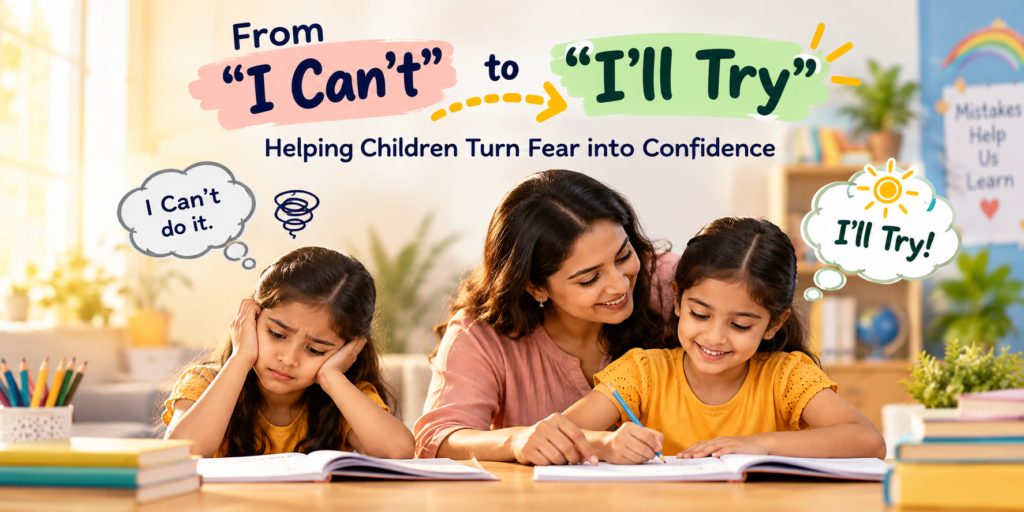
🌟 From “I Can't” to “I'll Try”: Helping Children Turn Fear into Confidence
💭 “I can’t do it.” “What if I get it wrong?” “I’m not good enough.”
Have you ever heard your child say these words when facing a difficult homework assignment, preparing for an exam, or trying something new?
As parents, it is natural to want to protect children from disappointment. But sometimes, the most valuable lesson is not how to avoid failure, but how to face it with confidence.
When children begin to fear mistakes, they may hesitate to ask questions, avoid challenges, or give up before discovering what they are capable of achieving. With the right encouragement, however, they can learn that making mistakes is a normal part of growing and learning.
✨ The journey from “I can’t” to “I’ll try” begins with small steps: recognising effort, celebrating progress, and creating an environment where children feel safe to learn at their own pace.
In this article, let’s explore practical ways parents can help children overcome the fear of failure, develop a growth mindset, and approach new challenges with greater confidence.
🤔 Why Are Children Afraid of Failure?
Children do not always know how to handle disappointment, criticism, or the pressure to perform well. Their fear of failure can develop through everyday experiences at home, in school, and among their peers.
Understanding the reasons behind this fear can help parents respond with patience and support.
📚1. Pressure to Get Good Marks: Children may begin to believe that their marks determine their intelligence or worth. When academic performance becomes the main measure of success, even a small mistake can feel overwhelming.
😟2. Fear of Being Judged: Some children hesitate to answer questions in class because they worry that others might laugh at them if they get an answer wrong. This fear can prevent them from participating and expressing their ideas.
🔄3. Constant Comparison With Others: Comparisons with siblings, friends, or classmates can make children feel that they are not doing enough. Over time, they may focus more on being better than others than on improving their own abilities.
💪4. Lack of Self-Confidence: A child who has struggled with a subject, lost a competition, or received a disappointing result may begin to doubt their abilities. They might avoid similar challenges because they do not want to experience the same disappointment again.
🎯5. The Desire to Be Perfect: Some children feel uncomfortable when things do not go exactly as planned. They may spend too much time trying to get everything right or abandon a task when they encounter difficulties.
Children need to understand that learning is not about getting everything right the first time. It is about trying, practising, learning, and gradually improving.
🚀 7 Ways Parents Can Help Children Overcome the Fear of Failure
Building confidence takes time. Parents can help children develop a healthier attitude towards mistakes through small, consistent actions in everyday life.
🌱 1. Praise Effort, Not Just Results
Children often receive praise for high marks, winning competitions, or completing tasks perfectly. While celebrating achievements is important, recognising the effort behind those achievements is equally valuable.
Instead of saying, “You are so smart because you got full marks,” try saying, “I noticed how much you practised for this test. Your hard work is paying off.”
When children understand that their efforts matter, they can become more willing to practise, improve, and tackle difficult tasks.
💡 Remember: Celebrate progress, persistence, and the willingness to learn, not just the final outcome.
💡 2. Teach Children That Mistakes Are Part of Learning
Making mistakes is a natural part of learning something new. A child might get a mathematics problem wrong, struggle with a new sport, or forget a line during a classroom presentation.
Rather than treating these moments as failures, help your child understand what can be learned from them.
Try asking:
🔍 What do you think went wrong?
💭 What could you try differently next time?
🌟 What did you learn from this experience?
These conversations encourage children to reflect on their experiences and look for solutions instead of becoming discouraged.
🪜 3. Break Big Challenges Into Small Steps
A difficult task can feel overwhelming when children do not know where to begin.
For example, if your child struggles with a long homework assignment, help them divide it into smaller, manageable tasks. Start with one question, take a short break if needed, and then move to the next.
You can also encourage your child to set small, realistic goals and celebrate each step forward.
🎉 Small steps lead to big progress! Completing one task at a time can make challenges feel more manageable and help children develop confidence.
❤️ 4. Avoid Comparing Your Child With Others
Every child has different strengths, interests, and learning needs. Some children understand a concept quickly, while others need more time and practice.
Statements such as “Your friend can do it, so why can’t you?” may unintentionally increase self-doubt.
Instead, help your child recognise their own progress.
You might say, “Last month, you found these questions difficult. Look at how much more you can do now.”
🌈 Every child has their own learning journey. Give your child the time and encouragement they need to recognise their abilities and work towards their goals.
👨👩👧 5. Be a Positive Role Model
Children learn from observing how adults handle challenges and disappointments.
If you make a mistake at work, struggle with a new task, or face an unexpected problem, show your child how you respond constructively.
You could say, “That didn’t work as I expected. I’ll think about what went wrong and try another way.”
When children see adults respond to mistakes with patience and a willingness to learn, they can begin to approach their own challenges in the same way.
🧩 6. Encourage Children to Try Before Offering Help
When children struggle, it is natural for parents to want to solve the problem immediately. However, stepping in too quickly can sometimes limit opportunities for children to practise independent thinking.
Instead, offer guidance without taking over.
When your child says, “I can’t do it,” try responding with:
💬 “Let’s look at it together. Which part do you think you can try first?”
Give your child time to think, experiment, and find a solution. Offer help when necessary, but allow them to take an active role in solving the problem.
Each attempt gives children an opportunity to practise decision-making, problem-solving, and independent learning.
🏆 7. Celebrate Courage, Not Just Winning
Not every effort will result in a prize, the highest marks, or immediate success. However, trying something difficult can be an achievement in itself.
Praise your child for raising their hand in class, participating in a competition, attempting a challenging question, or returning to a task after struggling.
You might say, “I’m proud of you for trying, even though you felt nervous.”
🌟 When children learn that their efforts are valued regardless of the outcome, they may become more comfortable taking on new challenges.
💬 What Should Parents Say When a Child Says “I Can't Do It”?
The way parents respond when children feel discouraged can influence how they view their abilities and challenges.
Here are some supportive phrases you can use in everyday situations.
📚 When your child struggles with homework
❌ Instead of: “This is easy. Why can’t you understand it?”
✅ Try: “It’s okay if it feels difficult right now. Let’s work through it step by step.”
📝 When your child receives a low mark
❌ Instead of: “You should have studied harder.”
✅ Try: “Let’s understand which topics were difficult and make a plan for next time.”
🎤 When your child is afraid to participate
❌ Instead of: “Don’t be scared. Just do it.”
✅ Try: “It’s normal to feel nervous when trying something new. Would you like to practise together first?”
💡 When your child makes a mistake
❌ Instead of: “You always make careless mistakes.”
✅ Try: “Everyone makes mistakes. Let’s see what we can learn from this one.”
💪 When your child wants to give up
❌ Instead of: “You never finish what you start.”
✅ Try: “You’ve already made a start. What’s one small thing you could try next?”
❤️ These simple changes can help children feel heard and supported while encouraging them to take responsibility for their learning.
🏫 How Can Schools Help Children Build Confidence?
A child’s confidence develops through experiences at home, in the classroom, and in interactions with others. Parents play an important role, but schools also have an opportunity to help children develop resilience and a positive attitude towards learning.
A supportive learning environment encourages students to ask questions, express their ideas, explore different solutions, and learn from mistakes without being afraid of embarrassment.
Teachers can help by recognising individual progress, offering constructive feedback, encouraging classroom participation, and giving students opportunities to solve problems independently.
🎨 Activities such as group projects, presentations, debates, sports, creative assignments, and classroom discussions can also help children practise communication, teamwork, decision-making, and perseverance.
Equally important is recognising that children learn at different paces. Providing appropriate guidance and opportunities for practice can help students develop confidence in their abilities.
When parents and teachers work together, children receive a consistent message: learning is a process, mistakes are part of that process, and improvement takes time.
At Sarathi School, a supportive and engaging learning environment can help students explore their interests, participate actively, and approach new challenges with a willingness to learn.
🌈 Final Thoughts: Help Your Child Take the First Step
When your child says, “I can’t do it,” remember that the moment is an opportunity to help them develop a more positive relationship with challenges.
Listen to their concerns, acknowledge their feelings, and encourage them to take one small step forward. Avoid unnecessary comparisons, recognise their efforts, and remind them that improvement takes time.
Children do not need to succeed at everything immediately. They need opportunities to practise, ask questions, make mistakes, and discover their own strengths.
With patience, encouragement, and consistent support from parents and teachers, children can gradually learn to replace self-doubt with confidence and hesitation with a willingness to try.
✨ The next time your child faces a difficult task, remind them that they do not have to know everything or get everything right the first time. They only need to be willing to begin.
At Sarathi School, we believe every child’s learning journey is an opportunity to discover, grow, and build confidence. Together, let’s encourage children to embrace challenges, learn from mistakes, and believe in the possibilities ahead. 🌟
📢 Admissions Open for 2026–27
If you’re looking for a CBSE school in Habsiguda that focuses on meaningful learning along with the overall development of every child, Sarathi School provides an environment where students are encouraged to learn, explore, think, and grow with confidence.
Because education is not only about knowing the answers.
It is also about having the courage and curiosity to ask the right questions.
Admissions are now open for the Academic Year 2026–27.
👉 Visit our campus or connect with us to discover how Sarathi School can support your child’s learning journey.


