
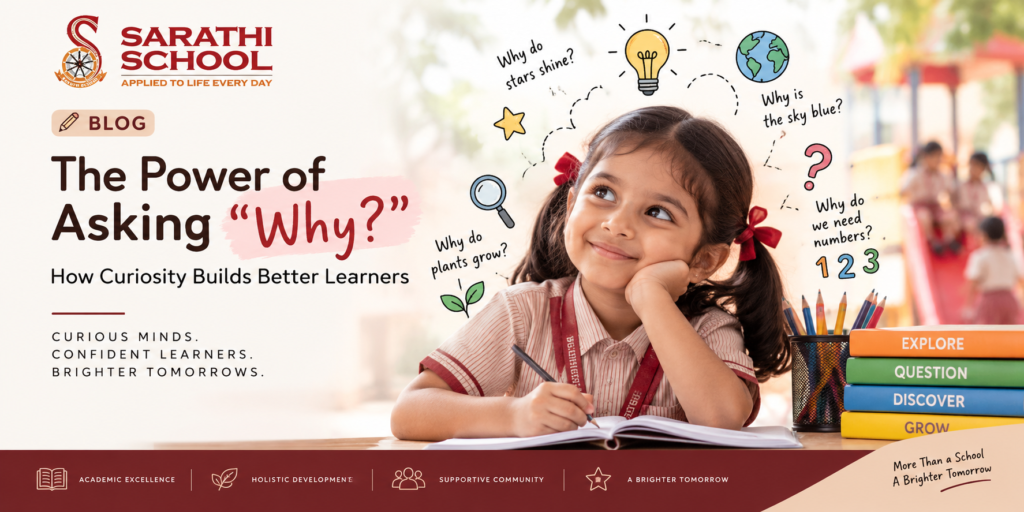
The Power of Asking “Why?”: How Curiosity Builds Better Learners
Children ask questions all day long.
“Why does it rain?”
“Why do birds fly?”
“Why do we need numbers?”
“Why does the moon look different every night?”
For adults, these questions can sometimes feel endless. But for a child, every “Why?” represents something much more meaningful.
It is a desire to understand.
It is an attempt to connect ideas.
It is the beginning of discovery.
As parents and educators, we often focus on whether children are getting the right answers. But perhaps an equally important question is:
Are we giving children enough opportunities to ask questions?
A child who asks questions is not simply being curious about the world around them. They are learning how to observe, think, explore, and make sense of new information.
At Sarathi School, we believe that meaningful learning begins when children are encouraged to wonder, question, explore, and discover. When curiosity becomes part of everyday learning, education becomes more than remembering information—it becomes a journey of discovery.
Let’s explore why one simple question—“Why?”—can make such a powerful difference in a child’s learning journey.
🧠 Curiosity Is Where Learning Begins
Children are naturally curious.
They notice small details. They observe what adults do. They experiment with objects around them. They ask questions about things that may seem obvious to us.
That curiosity creates a natural desire to learn.
When a child wonders why a plant needs sunlight, they are already beginning to explore science.
When they ask why some shapes have different properties, they are beginning to think mathematically.
When they ask why people speak different languages, they are discovering the world around them.
Curiosity gives children a reason to learn.
Instead of simply receiving information, they become interested in finding out what happens next.
And when children genuinely want to know something, learning becomes much more engaging.
❓ “Why?” Helps Children Think Beyond the Answer
Knowing an answer is useful.
Understanding why the answer is correct is even more valuable.
When children ask questions, they begin to look for explanations rather than simply memorising facts.
For example, instead of only learning that plants need sunlight, a curious child may wonder what happens when a plant doesn’t receive enough light.
That second question opens the door to deeper learning.
Questioning encourages children to make connections, compare ideas, identify patterns, and think about possibilities.
Over time, these habits help develop critical thinking—the ability to look at information carefully and form thoughtful conclusions.
🔎 Questions Turn Children Into Explorers
A question often leads to another question.
And another.
That is one of the most exciting things about curiosity.
A child who asks, “How does a rainbow form?” may want to find out about sunlight, water droplets, colours, and reflection.
Instead of simply being told the answer, they can observe, investigate, read, experiment, and discuss.
This kind of learning encourages children to become active participants.
They don’t simply wait for information to arrive.
They look for it.
They test ideas.
They make observations.
They discover connections.
In this way, a simple question can turn an ordinary lesson into an opportunity for exploration.
💡 Curiosity Makes Learning More Meaningful
Children are more likely to remember something when they understand how it connects to the world around them.
Imagine learning about measurement only through numbers in a textbook.
Now imagine measuring objects around the classroom, comparing their sizes, or working out how much material would be needed for a simple project.
The concept becomes easier to understand because children can see it, use it, and experience it.
The same can happen across subjects.
Science can involve observation and experiments.
Mathematics can involve real-life problem-solving.
Languages can involve conversations and creative expression.
Social studies can begin with questions about communities, people, and everyday life.
When curiosity connects classroom learning with real experiences, lessons become more memorable and meaningful.
🗣️ A Classroom Where Every Question Matters
Sometimes children stop asking questions because they are worried about being wrong.
They may think:
“What if everyone laughs at me?”
“What if my answer sounds silly?”
“What if I ask something that everyone else already knows?”
A supportive classroom can change that.
When students know that their questions are welcomed, they become more comfortable sharing their thoughts.
They begin to understand that not knowing something is not a weakness.
It is an opportunity to learn.
Teachers play an important role in creating this environment by listening patiently, encouraging discussion, and allowing students to explore different ideas.
At Sarathi School, nurturing an environment where students can express their thoughts and ask questions helps make learning a more engaging and confident experience.
Because sometimes, the most valuable contribution a child can make to a classroom is simply asking:
“Why?”
🌱 Let Children Discover Some Answers for Themselves
As adults, it can be tempting to give children the answer immediately.
It is quicker. It saves time.
But sometimes, the learning becomes more valuable when children have the opportunity to find the answer themselves.
If a child asks why something happens, instead of immediately explaining it, we can ask:
“What do you think?”
That small response encourages the child to think before receiving the answer.
They may make a prediction. They may get it wrong. They may change their idea after discovering something new.
And that process is learning.
Children don’t need to have the correct answer every time. They need opportunities to think, try, make mistakes, and try again.
👨👩👧 How Parents Can Keep Curiosity Alive at Home
Curiosity doesn’t stop when the school day ends.
Everyday life provides countless opportunities for children to ask questions and explore ideas.
Parents can encourage this by:
Listening to their questions instead of dismissing them.
Asking what they think before giving them an answer.
Exploring answers together through books, observations, conversations, or simple activities.
Encouraging them to notice things around them.
Allowing them to experiment and learn from mistakes.
Even a simple walk, a visit to a market, cooking together, or looking at the night sky can become a learning experience when children are encouraged to observe and question.
The goal isn’t to have an answer for every question.
Sometimes, saying “Let’s find out together” can be an even better answer.
🌟 From Curious Questions to Confident Learners
Curiosity doesn’t only help children learn school subjects. It can shape the way they approach challenges throughout life. A curious child is more likely to explore different possibilities. They become comfortable asking for information. They learn to investigate before reaching conclusions. They become more willing to try unfamiliar things. And gradually, they develop confidence in their own ability to learn. These qualities become increasingly valuable as children grow. Because the world will continue to change, new questions will emerge, and not every problem will have an answer waiting in a textbook. Children need to know how to find, understand, and use knowledge. Curiosity helps build that foundation.
🏫 Creating Curious Minds at Sarathi School
A meaningful learning environment should give children more than information.
It should give them reasons to explore it.
At Sarathi School, we believe that children learn best when they are actively involved in the learning process.
Through engaging classroom experiences, discussions, activities, projects, practical learning opportunities, and supportive teachers, students are encouraged to think beyond simply finding the “right answer.”
They are encouraged to ask questions, share ideas, explore possibilities, and understand the concepts they learn.
Because every child has a natural sense of wonder.
The role of education is not to silence that curiosity.
It is to help it grow.
🌈 Never Silence a Curious Mind
The next time a child asks “Why?”, pause for a moment.
Behind that one small word could be a new idea waiting to emerge.
A question could lead to an experiment. An experiment could lead to a discovery. A discovery could lead to a new interest. And a new interest could eventually become a lifelong passion. Children don’t need to know everything. They need the confidence to keep asking, exploring, and learning. Because a curious child doesn’t simply learn what the world is. They want to understand why it is the way it is. And that curiosity can become one of the most powerful tools they carry into the future.
📢 Admissions Open for 2026–27
Every child deserves a learning environment where questions are welcomed, ideas are encouraged, and curiosity has room to grow.
If you’re looking for a CBSE school in Habsiguda that focuses on meaningful learning along with the overall development of every child, Sarathi School provides an environment where students are encouraged to learn, explore, think, and grow with confidence.
Because education is not only about knowing the answers.
It is also about having the courage and curiosity to ask the right questions.
Admissions are now open for the Academic Year 2026–27.
👉 Visit our campus or connect with us to discover how Sarathi School can support your child’s learning journey.


